

MICROSCOPES AND SYSTEMS FOR IMAGE ANALYSIS / Metallographic microscopes

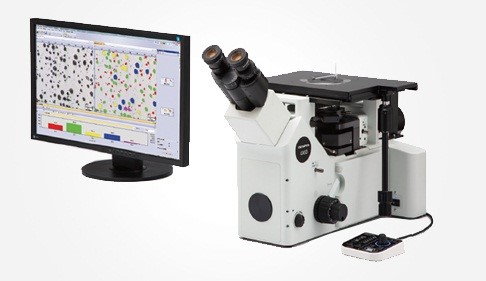
OLYMPUS GX53 MICROSCOPE
Olympus GX53 metallographic microscope is intended for use in metallurgy, automotive, electronic and other industries. The GX53 microscope provides clear, detailed images that can be difficult using traditional microscopy methods.
Read More
The advanced analysis tools of the GX53 microscope provide users with important advantages.
MXPLFLN lenses extend the possibilities for dark field imaging while simultaneously increasing the numerical aperture and working distance. Higher resolution at 20x and 50x magnification usually means shorter working distances, forcing you to remove the specimen or retract the objective when changing the objective. In many cases, the 3 mm working distance of the MXPLFLN series eliminates this problem, providing faster control with less chance of the lens touching the specimen.
The MIX dark field observation mode is combined with another observation method, such as bright field or polarized light, which allows detailed examination of samples that are difficult to examine with traditional microscopes. The ring LED illuminator has the functions of a directional dark field, that is, only one or several areas are illuminated at a given time, due to which glare is reduced and the texture of the surface is displayed much more clearly.
The Olympus GX53 microscope in combination with the PRECiV software enables the analysis of the structure of metals according to industry standards. With clear step-by-step instructions, users can easily and quickly perform sample analysis.
With the special Image Stitching Module (MIA), users can stitch together images by rotating the XY axis knobs (motorized stage is optional). PRECiV software uses feature recognition to create a panoramic image, ideal for monitoring the plastic deformation and carburization of steel.
PRECiV’s extended focus function (EFI) allows you to image samples whose height exceeds the depth of focus. The EFI function combines these images into a single focused image of the sample. Even when analyzing a cross-section of a sample with a rough surface, EFI produces fully focused images.
EFI works with manual and motorized Z-axis and creates a height map for rendering structures.
Using advanced image processing technology, the High Dynamic Range (HDR) function corrects differences in brightness in the image to eliminate glare. This function also allows you to sharpen the image. HDR can be used to observe fine structures in electrical devices and the structure of grain boundaries in metals.
The counting and measuring function uses thresholding methods to separate objects (particles, scratches) from the background. More than 50 different parameters for measuring and classifying objects are available to the operator, including shape, size, position and pixel properties.